Netomi - Conversational AI
Samples under a no-publish NDA. Inquire about what can be shared in-call.
Title:
UX Lead & Manager
UX Team Size:
3-5
Duration:
2022-2025
Netomi is a conversational AI leader helping enterprises like Brex, WestJet, and Singtel transform customer service through intelligent customer engagement automation. Their Agentic Studio enables teams to build and deploy AI agents across chat, SMS, voice, and email—handling millions of interactions monthly with industry-leading resolution rates.
Since 2022, I've built Netomi's UX function from the ground up. I joined a company where two junior designers were directed by PMs and no formal UX processes, design systems, or research practices existed. Over three years as Lead and Manager, I established all UX foundations, scaled the team to five designers, and partnered with Leadership, PMs, Engineering, and Customer Success to shape product direction.For a larger context, I recommend viewing in landscape mode for tablet / desktop view.

Agentic Studio 101
A quick visual overview of Netomi's Agentic Studio. Already familiar with Conversational AI platforms? Skip ahead.
Learn more
UX Management
Overview
Established all UX team practices and guided continual design system structure and improvements.
In this previously engineering-first environment, I established UX where none existed. Product managers were initially hesitant, but growing trust through results allowed teams to recognize UX's value. My early visionary drive evolved into balanced servant-leadership as the team grew and UX matured, empowering designers to deliver great experiences independently.
Visionary Leadership
Past experience in big data and customer-agent interactions guided vision.
Solution Storytelling
Guided problem-solution framing and flows built around personas and outcomes.
UX Team Support
1-1s, bi-weekly reviews, company-wide progress reports, and more.
Task Assign Balancing
Led distribution among designers based on their strengths and seniority.
Team/Leadership Balancing
Balanced improving UX files and structures while hitting monthly PM-driven targets.
UX Hiring Manager
Working with HR and candidate feedback, I refined the UX hiring and testing process.
Deliver > Release
Worked to align the UX > Eng/QA pipeline, seeking to reduce tech debt.
Quarter Planning
Worked closely with PMs, VPs and other leaders on yearly/quarterly planning and goals.
UX <> Marketing
Worked closely with Marketing team to streamline shared files and systems.
Customer Insights
We used HotJar and other insight tools, partnering with Customer Success to understand user needs.
Competitor Research
We tracked competitors and market trends, using insights to guide product decisions.
UX Guide Docs
Created extensive Confluence and Figma-based UX onboard and training docs.
Product Wins
Overview
Delivered key product capabilities and features that scaled Netomi's Conversational AI platform across multiple product areas.
At the heart of our work at Netomi, the team and I continually elevated and refined the design system, ensuring consistency and scalability across the product as our foundation. This ongoing effort enabled us to move faster, maintain quality, and create cohesive experiences as the product grew in complexity and reach.
Design System Evolution
Continually refined and scaled the design system for consistency across the product.
Established Personas
Through research, defined user personas across Netomi, Partnerships and individual Orgs.
Product Rebrand
Provided leadership across all product and marketing.
Admin Integration
Merged a separate admin tool into Agentic Studio for full Org control of workforce and bot deployment.
Self-Serve Transform
Led UX strategic transformation of self-service capabilities in Agentic Studio.
AI Response Uplift
Led UX efforts to enhance AI workflows with actions and guardrails in Agentic Studio.
Customer Onboarding
Led design of a new onboard routine in Agentic Studio with fast demo bot building.
Widget & Builder Uplift
Led Netomi’s chat widget uplift, improving UI and settings, marketing and survey features.
Analytics Uplifts
Guided multiple dashboards reflecting quantitative and qualitative data.
AI Response Tester
Established vision for global response tester in Agentic Studio, streamlining review.
Training Platform
Led vision for a YouTube-like video training UI within Agentic Studio.
SMB Market Expansion
Researched SMB to scale beyond Enterprise in Agentic Studio.
AgentDesk AI Copilot
Outside internal product, we built advanced AI assist plug-ins for AgentDesk platforms.
“Paul ... invests time in mentoring other designers, sharing insights, and helping teammates grow. His ... thoughtful ... feedback makes a real difference.”

Sr. Product Manager
“Paul... provides constructive, detailed feedback based on his extensive experience, helping us refine our skills and push our work to the next level.”

Gina Park
UI Designer
"Paul's skill in aligning design objectives clearly with business goals has noticeably increased the visibility and influence of design within the company”

Bogdan Laga
Sr. UX Designer
Netomi - Conversational AI
Samples under a no-publish NDA. Inquire about what can be shared in-call.
Building UX from the Ground Up
Netomi is a conversational AI leader helping enterprises like Brex, WestJet, and Singtel transform customer service through intelligent customer engagement automation. Their Agentic Studio enables teams to build and deploy AI agents across chat, SMS, voice, and email—handling millions of interactions monthly with industry-leading resolution rates.
Since 2022, I've built Netomi's UX function from the ground up. I joined a company where two junior designers were directed by PMs and no formal UX processes, design systems, or research practices existed. Over three years as Lead and Manager, I established all UX foundations, scaled the team to five designers, and partnered with Leadership, PMs, Engineering, and Customer Success to shape product direction.
Below, I've organized my work into three aspects:
Agentic Studio 101
A quick visual overview of Netomi's Agentic Studio. Already familiar with Conversational AI platforms? Skip ahead.
Learn more

Product Evolution - Establishing UX Foundations
When I joined Netomi, UX lacked formal ownership, structure, and scalable foundations. Designers worked reactively under Product direction, and while some UI patterns existed, no cohesive design system or scalable UX practices governed the platform. This limited consistency, team growth, and strategic product impact.
Working closely with Leadership, Product, and Engineering, I established UX as a core product function and positioned the team as a strategic partner across initiatives.
UX Ownership and Operating Model
Defined UX roles, responsibilities, and engagement model, ensuring UX became an embedded and trusted partner in product development.
Design System Foundations
Created unified, reusable UI standards to replace scattered patterns, improve usability, and accelerate development velocity.
UX Workflow Integration
Established structured UX → Engineering workflows, improving handoff clarity, reducing friction, and enabling more efficient delivery.
Team Growth and Structure
Scaled the UX team and introduced structured reviews, mentorship, and operational practices to support consistent quality and long-term growth.
Impact
UX transitioned from a reactive support role to a strategic function, establishing the foundation that enabled all subsequent product evolution initiatives, with broad-scale impactful initiatives detailed below.
Competitive Research
Throughout my tenure, we continuously analyzed key competitors in Conversational AI. Each offers a studio-like, no-code, omni-channel SaaS tool for building, testing, deploying, and optimizing AI agents with the latest LLM solutions.
A general checklist of features and aspects we explored during my tenure:
Self-Serve
Integrations
Ease of Use
Conversational Accuracy
Multi-LLM Support
Security & Compliance
Customization
Scalability
Support & Training
Reputation
Innovation
Established User Personas
When I started, Agentic Studio's flat user structure was its most significant limitation. Every user had unrestricted access, with no role-based permissions. To scale the platform and ensure appropriate access controls, this needed to change.
I led the UX team in developing user personas tied to permission levels, working closely with PM and CS teams. We interviewed:
Netomi
Netomi internal teams to establish hierarchies and to provide ongoing feedback.
Partnerships
Partnerships that were forming to resell the platform, requiring unique administrative needs.
Customer Base
Orgs to identify their granular team needs within the platform.
Impact
Established three clear user tiers within the platform, each containing 4–5 personas with distinct hierarchies and permission sets. Beyond opening the door to advanced features, this work enhanced my team's storytelling capabilities.
Enhanced AI Agent Capabilities
As LLMs like ChatGPT and Claude emerged, Netomi integrated these models into Agentic Studio, expanding beyond their in-house AI. This brought broader capabilities but introduced challenges in managing LLM outputs. Simultaneously, demand grew for AI Agents to perform "agentic" tasks—booking flights, scheduling appointments—on behalf of users. This required building new tools while maintaining the familiar foundation of workflows and training data.
Working with our Lead PM, I led the UX team in architecting three foundational layers that work across any LLM provider:
AI Persona
Provides consistent behaviour regardless of LLM. Defines tone, style, and guardrails so conversations stay on-brand whether powered by models like GPT, Claude, or Netomi's.
Prompts
Model-agnostic instruction layers shaping responses across LLMs. These modular components replace rigid workflows with flexible guidance adapting to any provider's capabilities.
Actions
Universal execution layer that turns any LLM's output into tangible outcomes like API calls, data transactions, and workflow triggers, decoupled from the generating model.
Impact
These layers provided the guardrails, flexibility, and capabilities customers needed to confidently leverage third-party LLMs, strengthening Netomi’s competitive position in Conversational AI.
Unified Conversational Testing
As the Agentic layers grew within Agentic Studio, users needed to test how all configurations worked together in a real conversational flow—not just components in isolation. I designed a global conversational tester that provides a holistic preview of the end-user experience, surfacing high-level controls from all sections in a single window so users can toggle settings and validate the complete conversational output in real-time.
Two complementary testing approaches:
Per-Section Testing
Enhanced per-section testing capabilities for conversational elements including prompts and actions.
Global Tester
Built a unified chat widget within Agentic Studio that surfaces high-level controls from all sections, enabling users to test layered conversational outputs in one place.
Impact
The global tester enables real-time testing of end-customer interactions without leaving the workspace, streamlining validation while maintaining granular per-section control.
Enhanced Decision-making Reporting
Conversational AI requires continuous post-release refinement based on end-customer data and AI performance. This requires robust monitoring and analysis of historical data to identify trends, issues, and inform improvements. We built quantitative and qualitative dashboards and reporting layers to help customers track performance, sentiment, and make data-driven refinements.
I led the UX team in designing several complementary reporting layers:
Admin Level
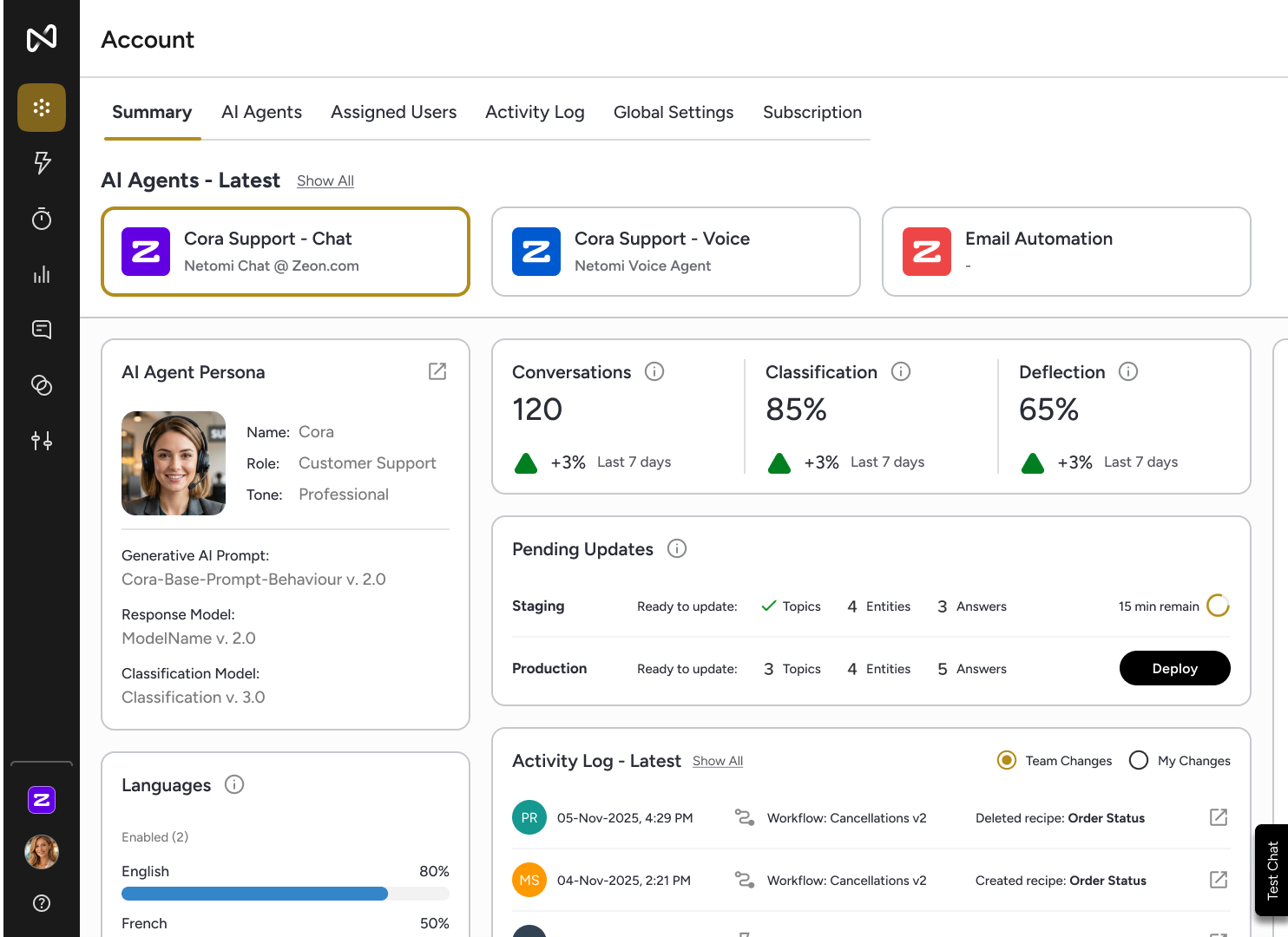
The new Account section's overview dashboard provides a high-level snapshot of currently deployed AI performance and pre-trained configurations for immediate review.
Quantitative
The primary Analytics platform within Agentic Studio tracks comprehensive historical metrics and performance trends. We completely overhauled and continually refined this area to surface actionable insights from aggregate data.
Qualitative
The Conversation Viewer section enables drill-down analysis at the individual conversation level, surfacing sentiment, satisfaction, keywords, and contextual patterns to understand the "why" behind the numbers.
Impact
These reporting layers empower organizations to analyze historical performance data, identify patterns and problems, and make informed decisions about how to refine their AI agents. Teams can then take corrective action and redeploy improved versions with confidence.
Netomi Chat Widget Uplift
While Netomi integrated with many chat platforms, we transformed our in-house widget from a basic tool into a competitive differentiator. By building a custom solution tailored to our customers' needs, we could deliver capabilities that generic third-party chat widgets couldn't match.
Three key improvements:
Widget Uplift
Completely overhauled the chat widget component, even building its own custom design system, improving visual design while adding advanced features and enabling better scalability.
Configuration Uplift
Redesigned the configuration section within Agentic Studio with live preview mode, intuitive settings categories, and multi-device/screen size support for improved feature scaling and realistic end-customer visualization.
CX Features
The new widget and settings enabled personalization capabilities that surface relevant articles and offers based on user queries, sentiment tracking throughout the end-user journey, and real-time engagement features such as conversational context-sensitive promotions tailored to conversational keywords.
Impact
The enhanced chat widget became a competitive differentiator, enabling enterprise customers to deploy a sophisticated, brandable conversational interface directly from Agentic Studio—combining enterprise-grade configuration controls with consumer-grade user experience in a single, unified solution.
User Guidance & Communication
As Agentic Studio's complexity grew, users needed better guidance and communication within their workflow. Help documentation and training resources existed as external tools, requiring users to leave the platform to learn. Additionally, system notifications and banners were cryptic and lacked clear hierarchy, leaving users uncertain about platform status and changes.
Three key improvements:
What's New? Panel
Designed an in-app feature update panel that appears at login following a new release of Agentic Studio, presenting a carousel of new capabilities with screenshots and links to full documentation. This both informed users of platform updates and promoted the separate help portal, driving engagement with timely feature information beyond general knowledge.
Integrated Training Library
Delivered a YouTube-like training section directly within Agentic Studio, featuring introductory videos and pathways to Netomi U certification. This surfaced learning resources within the platform while bridging to external certification programs.
Notifications & Banners Uplift
Worked with Engineering and copywriting over several months to establish clear visual hierarchy and messaging standards for system notifications, transforming cryptic alerts into actionable, contextual communication.
Impact
These improvements increased clarity and confidence in using Agentic Studio, reducing user confusion through better messaging and accessible training resources surfaced directly within the platform.
UX Management
Overview
Established all UX team practices and guided continual design system structure and improvements.
In this previously engineering-first environment, I established UX where none existed. Product managers were initially hesitant, but growing trust through results allowed teams to recognize UX's value. My early visionary drive evolved into balanced servant-leadership as the team grew and UX matured, empowering designers to deliver great experiences independently.
Visionary Leadership
Past experience in big data and customer-agent interactions guided vision.
Solution Storytelling
Guided problem-solution framing and flows built around personas and outcomes.
UX Team Support
1-1s, bi-weekly reviews, company-wide progress reports, and more.
Task Assign Balancing
Led distribution among designers based on their strengths and seniority.
Team/Leadership Balancing
Balanced improving UX files and structures while hitting monthly PM-driven targets.
UX Hiring Manager
Working with HR and candidate feedback, I refined the UX hiring and testing process.
Deliver > Release
Worked to align the UX > Eng/QA pipeline, seeking to reduce tech debt.
Quarter Planning
Worked closely with PMs, VPs and other leaders on yearly/quarterly planning and goals.
UX <> Marketing
Worked closely with Marketing team to streamline shared files and systems.
Customer Insights
We used HotJar and other insight tools, partnering with Customer Success to understand user needs.
Competitor Research
We tracked competitors and market trends, using insights to guide product decisions.
UX Guide Docs
Created extensive Confluence and Figma-based UX onboard and training docs.
Product Wins
Overview
Delivered key product capabilities and features that scaled Netomi's Conversational AI platform across multiple product areas.
At the heart of our work at Netomi, the team and I continually elevated and refined the design system, ensuring consistency and scalability across the product as our foundation. This ongoing effort enabled us to move faster, maintain quality, and create cohesive experiences as the product grew in complexity and reach.
Design System Evolution
Continually refined and scaled the design system for consistency across the product.
Established Personas
Through research, defined user personas across Netomi, Partnerships and individual Orgs.
Product Rebrand
Provided leadership across all product and marketing.
Admin Integration
Merged a separate admin tool into Agentic Studio for full Org control of workforce and bot deployment.
Self-Serve Transform
Led UX strategic transformation of self-service capabilities in Agentic Studio.
AI Response Uplift
Led UX efforts to enhance AI workflows with actions and guardrails in Agentic Studio.
Customer Onboarding
Led design of a new onboard routine in Agentic Studio with fast demo bot building.
Widget & Builder Uplift
Led Netomi’s chat widget uplift, improving UI and settings, marketing and survey features.
Analytics Uplifts
Guided multiple dashboards reflecting quantitative and qualitative data.
AI Response Tester
Established vision for global response tester in Agentic Studio, streamlining review.
Training Platform
Led vision for a YouTube-like video training UI within Agentic Studio.
SMB Market Expansion
Researched SMB to scale beyond Enterprise in Agentic Studio.
AgentDesk AI Copilot
Outside internal product, we built advanced AI assist plug-ins for AgentDesk platforms.

“Beyond his expertise, Paul is a fantastic coach. He invests time in mentoring other designers, sharing insights, and helping teammates grow. His ability to provide thoughtful, constructive feedback makes a real difference.”
Chakri Josyam, Sr. Product Manager

“Paul is optimistic, knowledgeable, and forward-thinking... He provides constructive, detailed feedback based on his extensive experience, helping us refine our skills and push our work to the next level.”
Gina Park, UI Designer
www.ginapark.ca

"Paul (brings) ... strong strategic vision coupled with deep UX design expertise, particularly in developing intuitive, AI-driven user experiences ... Paul's skill in aligning design objectives clearly with business goals has noticeably increased the visibility and influence of design within the company”
Bogdan Laga, Sr. UX Designer
Netomi - Conversational AI
Samples under a no-publish NDA. Inquire about what can be shared in-call.
Building UX from the Ground Up
Netomi is a conversational AI leader helping enterprises like Brex, WestJet, and Singtel transform customer service through intelligent customer engagement automation. Their Agentic Studio enables teams to build and deploy AI agents across chat, SMS, voice, and email—handling millions of interactions monthly with industry-leading resolution rates.
Since 2022, I've built Netomi's UX function from the ground up. I joined a company where two junior designers were directed by PMs and no formal UX processes, design systems, or research practices existed. Over three years as Lead and Manager, I established all UX foundations, scaled the team to five designers, and partnered with Leadership, PMs, Engineering, and Customer Success to shape product direction.
Below, I've organized my work into three aspects:
Agentic Studio 101
A quick visual overview of Netomi's Agentic Studio. Already familiar with Conversational AI platforms? Please skip ahead to “Product Evolution.”
Learn more

Product Evolution - Establishing UX Foundations
When I joined Netomi, UX lacked formal ownership, structure, and scalable foundations. Designers worked reactively under Product direction, and while some UI patterns existed, no cohesive design system or scalable UX practices governed the platform. This limited consistency, team growth, and strategic product impact.
Working closely with Leadership, Product, and Engineering, I established UX as a core product function and positioned the team as a strategic partner across initiatives.
UX Ownership and Operating Model
Defined UX roles, responsibilities, and engagement model, ensuring UX became an embedded and trusted partner in product development.
Design System Foundations
Created unified, reusable UI standards to replace scattered patterns, improve usability, and accelerate development velocity.
UX Workflow Integration
Established structured UX → Engineering workflows, improving handoff clarity, reducing friction, and enabling more efficient delivery.
Team Growth and Structure
Scaled the UX team and introduced structured reviews, mentorship, and operational practices to support consistent quality and long-term growth.
Impact
UX transitioned from a reactive support role to a strategic function, establishing the foundation that enabled all subsequent product evolution initiatives, with broad-scale impactful initiatives detailed below.
Competitive Research
Throughout my tenure, we continuously analyzed key competitors in Conversational AI. Each offers a studio-like, no-code, omni-channel SaaS tool for building, testing, deploying, and optimizing AI agents with the latest LLM solutions.
Key features and aspects we explored to uplift or core product, Agentic Studio:
Self-Serve
Integrations
Ease of Use
Conversational Accuracy
Multi-LLM Support
Security & Compliance
Customization
Scalability
Support & Training
Reputation
Innovation
Established User Personas
Early on, Agentic Studio's flat user structure was its most significant limitation. Every user had unrestricted access, with no role-based permissions. To scale the platform and ensure appropriate access controls, this needed to change.
I led the UX team in developing user personas tied to permission levels, working closely with PM and CS teams. We interviewed:
Netomi
Netomi internal teams to establish hierarchies and to provide ongoing feedback.
Partnerships
Partnerships that were forming to resell the platform, requiring unique administrative needs.
Customer Base
Orgs to identify their granular team needs within the platform.
Impact
Established three clear user tiers within the platform, each containing 4–5 personas with distinct hierarchies and permission sets. Beyond opening the door to advanced features, this work enhanced my team's storytelling capabilities.
Enhanced AI Agent Capabilities
As LLMs like ChatGPT and Claude emerged, Netomi integrated these models into Agentic Studio—but faced a critical architectural challenge: how do you build a platform that works with any LLM while maintaining enterprise-grade control? Each model had different strengths, limitations, and behaviors. Customers needed the flexibility to choose or switch providers without rebuilding their entire conversational infrastructure. Traditional workflow-based approaches were too rigid, while pure LLM implementations lacked necessary guardrails.
Working with our Lead PM, I led the UX team in architecting three foundational layers that work across any LLM provider:
AI Persona
Provides consistent behaviour regardless of LLM. Defines tone, style, and guardrails so conversations stay on-brand whether powered by models like GPT, Claude, or Netomi's.
Prompts
Model-agnostic instruction layers shaping responses across LLMs. These modular components replace rigid workflows with flexible guidance adapting to any provider's capabilities.
Actions
Universal execution layer that turns any LLM's output into tangible outcomes like API calls, data transactions, and workflow triggers, decoupled from the generating model.
Impact
These layers provided the guardrails, flexibility, and capabilities customers needed to confidently leverage third-party LLMs, strengthening Netomi’s competitive position in Conversational AI.
Unified Conversational Testing
As the Agentic layers grew within Agentic Studio, users needed to test how all configurations worked together in a real conversational flow—not just components in isolation. I designed a global conversational tester that provides a holistic preview of the end-user experience, surfacing high-level controls from all sections in a single window so users can toggle settings and validate the complete conversational output in real-time.
Two complementary testing approaches:
Per-Section Testing
Enhanced per-section testing capabilities for conversational elements including prompts and actions.
Global Tester
Built a unified chat widget within Agentic Studio that surfaces high-level controls from all sections, enabling users to test layered conversational outputs in one place.
Impact
The global tester enables real-time testing of end-customer interactions without leaving the workspace, streamlining validation while maintaining granular per-section control.
Enhanced Decision-making Reporting
Conversational AI requires continuous post-release refinement based on end-customer data and AI performance. This requires robust monitoring and analysis of historical data to identify trends, issues, and inform improvements. We built quantitative and qualitative dashboards and reporting layers to help customers track performance, sentiment, and make data-driven refinements.
I led the UX team in designing several complementary reporting layers:
Admin Level
The new Account section's overview dashboard provides a high-level snapshot of currently deployed AI performance and pre-trained configurations for immediate review.
Quantitative
The primary Analytics platform within Agentic Studio tracks comprehensive historical metrics and performance trends. We completely overhauled and continually refined this area to surface actionable insights from aggregate data.
Qualitative
The Conversation Viewer section enables drill-down analysis at the individual conversation level, surfacing sentiment, satisfaction, keywords, and contextual patterns to understand the "why" behind the numbers.
Impact
These reporting layers empower organizations to analyze historical performance data, identify patterns and problems, and make informed decisions about how to refine their AI agents. Teams can then take corrective action and redeploy improved versions with confidence.
Netomi Chat Widget Uplift
While Netomi integrated with many chat platforms, we transformed our in-house widget from a basic tool into a competitive differentiator. By building a custom solution tailored to our customers' needs, we could deliver capabilities that generic third-party chat widgets couldn't match.
Three key improvements:
Chat Widget Uplift
Completely overhauled the customer-facing widget interface with improved visual design, responsive layouts, enhanced branding customization, and modern interaction patterns for a consumer-grade experience.
Config Uplift
Redesigned the configuration section within Agentic Studio with live preview mode, intuitive settings categories, and multi-device/screen size support for improved feature scaling and realistic end-customer visualization.
CX Features
The new widget and settings enabled personalization capabilities that surface relevant articles and offers based on user queries, sentiment tracking throughout the end-user journey, and real-time engagement features such as conversational context-sensitive promotions tailored to conversational keywords.
Impact
The enhanced chat widget became a competitive differentiator, enabling enterprise customers to deploy a sophisticated, brandable conversational interface directly from Agentic Studio—combining enterprise-grade configuration controls with consumer-grade user experience in a single, unified solution.
User Guidance & Communication
As Agentic Studio's complexity grew, users needed better guidance and communication within their workflow. Help documentation and training resources existed as external tools, requiring users to leave the platform to learn. Additionally, system notifications and banners were cryptic and lacked clear hierarchy, leaving users uncertain about platform status and changes.
Three key improvements:
What's New? Panel
Designed an in-app feature update panel that appears at login following a new release of Agentic Studio, presenting a carousel of new capabilities with screenshots and links to full documentation. This both informed users of platform updates and promoted the separate help portal, driving engagement with timely feature information beyond general knowledge.
Training Library
Delivered a YouTube-like training section directly within Agentic Studio, featuring introductory videos and pathways to Netomi U certification. This surfaced learning resources within the platform while bridging to external certification programs.
Notifications & Banners
Worked with Engineering and copywriting over several months to establish clear visual hierarchy and messaging standards for system notifications, defining global, regional, and page-specific banner types. This transformed cryptic alerts into actionable, contextual communication with appropriate urgency and placement.
Impact
These improvements increased clarity and confidence in using Agentic Studio, reducing user confusion through better messaging and accessible training resources surfaced directly within the platform.
UX Management
Overview
Established all UX team practices and guided continual design system structure and improvements.
In this previously engineering-first environment, I established UX where none existed. Product managers were initially hesitant, but growing trust through results allowed teams to recognize UX's value. My early visionary drive evolved into balanced servant-leadership as the team grew and UX matured, empowering designers to deliver great experiences independently.
Visionary Leadership
Past experience in big data and customer-agent interactions guided vision.
Solution Storytelling
Guided problem-solution framing and flows built around personas and outcomes.
UX Team Support
1-1s, bi-weekly reviews, company-wide progress reports, and more.
Task Assign Balancing
Led distribution among designers based on their strengths and seniority.
Team/Leadership Balancing
Balanced improving UX files and structures while hitting monthly PM-driven targets.
UX Hiring Manager
Working with HR and candidate feedback, I refined the UX hiring and testing process.
Deliver > Release
Worked to align the UX > Eng/QA pipeline, seeking to reduce tech debt.
Quarter Planning
Worked closely with PMs, VPs and other leaders on yearly/quarterly planning and goals.
UX <> Marketing
Worked closely with Marketing team to streamline shared files and systems.
Customer Insights
We used HotJar and other insight tools, partnering with Customer Success to understand user needs.
Competitor Research
We tracked competitors and market trends, using insights to guide product decisions.
UX Guide Docs
Created extensive Confluence and Figma-based UX onboard and training docs.
Product Wins
Overview
Delivered key product capabilities and features that scaled Netomi's Conversational AI platform across multiple product areas.
At the heart of our work at Netomi, the team and I continually elevated and refined the design system, ensuring consistency and scalability across the product as our foundation. This ongoing effort enabled us to move faster, maintain quality, and create cohesive experiences as the product grew in complexity and reach.
Design System Evolution
Continually refined and scaled the design system for consistency across the product.
Established Personas
Through research, defined user personas across Netomi, Partnerships and individual Orgs.
Product Rebrand
Provided leadership across all product and marketing.
Admin Integration
Merged a separate admin tool into Agentic Studio for full Org control of workforce and bot deployment.
Self-Serve Transform
Led UX strategic transformation of self-service capabilities in Agentic Studio.
AI Response Uplift
Led UX efforts to enhance AI workflows with actions and guardrails in Agentic Studio.
Customer Onboarding
Led design of a new onboard routine in Agentic Studio with fast demo bot building.
Widget & Builder Uplift
Led Netomi’s chat widget uplift, improving UI and settings, marketing and survey features.
Analytics Uplifts
Guided multiple dashboards reflecting quantitative and qualitative data.
AI Response Tester
Established vision for global response tester in Agentic Studio, streamlining review.
Training Platform
Led vision for a YouTube-like video training UI within Agentic Studio.
SMB Market Expansion
Researched SMB to scale beyond Enterprise in Agentic Studio.
AgentDesk AI Copilot
Outside internal product, we built advanced AI assist plug-ins for AgentDesk platforms.

“Beyond his expertise, Paul is a fantastic coach. He invests time in mentoring other designers, sharing insights, and helping teammates grow. His ability to provide thoughtful, constructive feedback makes a real difference.”
Chakri Josyam, Sr. Product Manager

“Paul is optimistic, knowledgeable, and forward-thinking... He provides constructive, detailed feedback based on his extensive experience, helping us refine our skills and push our work to the next level.”
Gina Park, UI Designer
www.ginapark.ca

"Paul (brings) ... strong strategic vision coupled with deep UX design expertise, particularly in developing intuitive, AI-driven user experiences ... Paul's skill in aligning design objectives clearly with business goals has noticeably increased the visibility and influence of design within the company”
Bogdan Laga, Sr. UX Designer